

Welcome to Evangelicalarminians.org

Welcome to the online home of the Society of Evangelical Arminians (SEA). Our society exists to glorify God by edifying his people, protecting them from error, and fostering the proper representation of our magnificent God to the world by lovingly and respectfully promoting and advancing sound, biblical doctrine and theology in the area of soteriology (the doctrine of salvation). That means teaching and defending Arminianism, the system of theology that we believe most accurately reflects the teaching of the Bible, the very word of God. It also means refuting Calvinism, a system of theology that lies within the pale of basic Christian orthodoxy, but that is at odds with Arminianism on many key points and that we believe seriously errs in its understanding of God, salvation, and the Bible.

I John 4:11-12; A Devotional

Beloved, if God so loved us, we ought also to love one another. 12 No man hath seen God at any time. If we love one another, God dwelleth in us, and his love is perfected in us.

John is furthering his command for us to love one another. The verb tense of the second love in verse 11 is actually the infinitive, meaning that the verse should probably be "So we ought to be loving one another." There is a clear sense of present action here, saying that this should already be happening, and if it isn't, it must start now.

Loving one another is truly important. We cannot see God. We cannot touch Him. I believe we can feel Him in our spirits, but at the present time, our interaction with Him is still pretty limited. So how do we know God is real? How do we feel God in our hearts? According to John, it is by loving one another!

Sola Paul (satire)

(Disclaimer: the following is an attempt at satire on the issue of the universality of the atonement)

In this post we will take look at the extent of the atonement. By using proper exegesis of scripture it can be proven with certainty that Jesus died to effectually secure salvation for Paul of Tarsus. And for Paul alone.

First, let's take a look at Galatians 2:20. This is the most important verse in the Bible, because it explicitly states the extent of the atonement (bold mine): "I have been crucified with Christ and I no longer live, but Christ lives in me. The life I live in the body, I live by faith in the Son of God, who loved me and gave himself for me."

Thomas Ralston on Freedom of the Will Part 9: The Doctrine of Motives

This post completes our series on Ralston’s defense of the Arminian belief in self-determinism. This is the grand finale where Ralston tackles the favorite argument against free-will, the doctrine of motives as presented primarily by Jonathan Edwards. This is especially relevant since Calvinists continue to argue along these same lines today and often hold up Mr. Edwards’ work as un-refuted and irrefutable. The following treatment by Thomas Ralston would suggest otherwise. I will not be interrupting his treatment with my comments so as to preserve the flow of his thought in this important critique. Enjoy.

III. We will now consider the objection to the view taken of free agency, which is founded upon the doctrine of motives.

We Now Have A Fully Working Search Function

Just a note to point out that we now have a fully working search function. If you have tried to use the searchbox we have had in the past, you probably discovered it did not work well at all. But now it works just swell! You can find the new searchbox on the upper righhand side of the page.

Thomas Ralston on Freedom of the Will Part 8: Can Free Agency be Harmonized With Divine Foreknowledge?

Thomas Ralston now tackles the necessitarian objection that God’s foreknowledge of our actions renders the power of self-determination impossible. My comments are in bold print.

II. The next grand objection to the doctrine of free agency is, that it is supposed to be irreconcilable with the Scripture account of the divine prescience.

Necessitarians argue that free agency, in the proper sense, implies contingency; and that contingency cannot be reconciled with the divine foreknowledge. It is admitted by Arminians, and the advocates of free agency generally, that the foreknowledge of God extends to all things great and small, whether necessary or contingent - that it is perfect and certain.

Thomas Ralston on Freedom of the Will Part 7: Is the Doctrine of Free Agency Absurd?

Thomas Ralston now begins to examine and respond to various objections posed by “necessitarians” against the Arminian view of self-determinism. My comments are in bold print.

WE propose in this chapter, to examine some of the principal objections which have been urged against the view taken in the preceding chapter of the freedom of the will. Those most worthy of notice are the following, viz.:

I. It is said to be absurd in itself.

II. It is said to be irreconcilable with the Scripture account of the divine prescience.

III. It is said to conflict with the doctrine of motives.

We propose a respectful attention to each of these grand objections.

I. It is alleged that the view we have taken of the proper freedom of the will is absurd in itself.

Thomas Ralston on Freedom of the Will Part 6: Conclusions to the Positive Argument

Thomas Ralston now concludes his positive arguments in favor of self-determinism. My comments are in bold print.

(4) In conclusion, upon this part of the subject, we think it proper briefly to notice the absurdity of attempting to reconcile the doctrines of necessity with the proper freedom and accountability of man.

I John 4:7-11; A Devotional

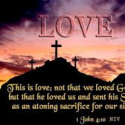
Beloved, let us love one another: for love is of God; and every one that loveth is born of God, and knoweth God. 8 He that loveth not knoweth not God; for God is love. 9 In this was manifested the love of God toward us, because that God sent his only begotten Son into the world, that we might live through him. 10 Herein is love, not that we loved God, but that he loved us, and sent his Son to be the propitiation for our sins. 11 Beloved, if God so loved us, we ought also to love one another.

Thomas Ralston on Freedom of the Will Part 5: The Scriptural Evidence

Ralston continues with his defense of free moral agency from Scripture. My comments are in bold print.

(2) In the next place, the Scriptures everywhere address man as a being capable of choosing; as possessing a control over his own volitions, and as being held responsible for the proper exercise of that control.

In Deuteronomy 30:19, we read: “I call heaven and earth to record this day against you, that I have set before you life and death, blessing and cursing; therefore choose life, that both thou and thy seed may live.” And in Joshua 24:15: “Choose you this day whom ye will serve.” Now, to choose is to determine or fix the will; but men are here called upon to choose for themselves, which, upon the supposition that their will is, in all cases, fixed necessarily by antecedent causes beyond their control, is nothing better than solemn mockery.

Thomas Ralston on Freedom of the Will Part 4: God's Divine Administration

Thomas Ralston begins his appeal to Scripture with his third evidence for self-determinism in his Elements of Divinity. My comments are in bold print.

3. Our third evidence of man’s proper free agency is founded upon the divine administration toward him, as exhibited in the Holy Scriptures.

Here we shall perceive that revelation beautifully harmonizes with nature; and those clear and decisive evidences of our free agency, which, as we have seen, are derived from experience and observation, are abundantly confirmed by the book of God.

Thomas Ralston on Freedom of the Will Part 3: The Argument From Universality

We continue with Ralston’s second argument for self-determinism from his Elements of Divinity. My comments are in bold print.

2. Our next argument for the self-determining power of the mind over the will is founded upon the history of the world in general.

Thomas Ralston on Freedom of the Will Part 2: Its Self-evident Nature

We now continue with Ralston’s defense of free will from his Elements of Divinity. My comments are in bold print.

II. We proceed now to consider some of the leading arguments by which the free moral agency of man, as briefly defined above, is established.

1.We rely upon our own consciousness.

Thomas Ralston on Freedom of the Will Part 1: Introducing the Controversy

Thomas Ralston was an early Methodist theologian. The following is taken from his Elements of Divinity (Wesleyan Heritage Collection CD). My comments will be in bold print.

The great question in this controversy is not whether a man can will “as he pleases,” for that is the same as to ask whether he can will as he does will. But the question is, Can a man will, without being constrained to will as he does, by something extrinsic to himself acting efficiently upon him? This is the real question on which depends the freedom of the mind in willing.

I John 4:4-6; A Devotional

Little children, you are from God and have overcome them, for he who is in you is greater than he who is in the world. 5 They are from the world; therefore they speak from the world, and the world listens to them. 6 We are from God. Whoever knows God listens to us; whoever is not from God does not listen to us. By this we know the Spirit of truth and the spirit of error.

Syndicate content